

In this story from October 1971, author and NFL legend Gale Sayers pays tribute to the courage and indomitable spirit of his dear friend and teammate, Brian Piccolo.
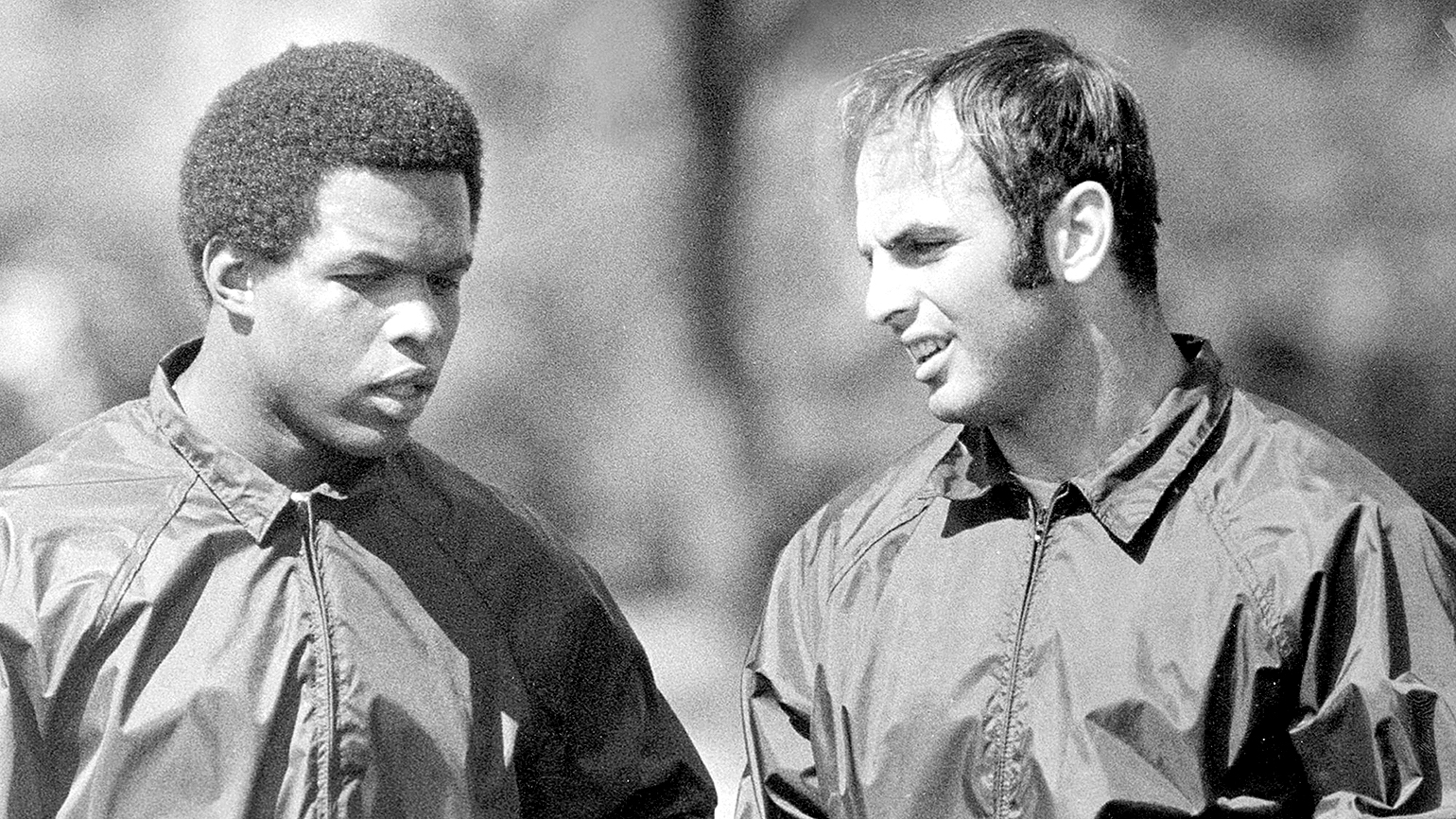
When I first saw Brian Piccolo at the Chicago Bears’ football practice back in 1966, I didn’t think he would make the team. “Pick” was not very big and not very fast, but he hung in there with determination and guts and became a solid all-around player.
The great thing about Pick was his sense of humor. When he was assigned a locker between me on one side and Dick Gordon on the other (both of us blacks), Pick, who is white, kidded us saying, “I feel like an Oreo cookie.” The fact that he was my substitute at running back didn’t bother him a bit. When the coaches graded his performance higher than mine during the 1968 season, he never let me forget it.
The best thing about our relationship as it developed was that we could kid each other all the time about race. It was a way, I guess, of easing into each other’s world. So when in 1967 the coaches began pairing roommates who played the same position, it was logical that Pick and I room together. When sports writers began trying to make a big deal of the black-white angle, we just joked about it.
Another great thing about Pick was his unselfishness. He was never uptight about his secondary role on the field. He would fill in at any position, hardly ever missed a block, always gave 100 percent. When I began the 1969 season worried about a postseason operation on my knee, Pick always had an encouraging word at the right moment even though he knew he would get a chance to play more if I couldn’t.
It was during the ‘69 season that Pick’s cough began. It wasn’t much at first but got worse as the season entered the cold months. Despite the cough, Pick played well. After one game when he scored a touchdown, he started coughing, then laughed saying, “It’s nothing. I’m just having a coronary.”
Finally Pick went to a doctor to get a stronger cough syrup. The doctor took an X-ray of his chest. “Brian’s very sick,” he said. “He’s got a malignant tumor in his chest that has to come out.”
I was stunned. I just didn’t know what to say or think. After practice Saturday, I went over to the hospital to see him. He was in a fantastic mood. “I’m ready to play, man,” he said. “It’s just a little cough, you know.” His wife, Joy, was with him, and she was in good spirits too. We kidded around for a while and then I left.
That night, the night before the Baltimore game, Mr. Halas, the team’s owner, called me. He said, “Gale, I think maybe you ought to say something to the team before we go out tomorrow. Try to dedicate the game to Brian. I think it would be altogether appropriate.”
And I said I would.
I had never in my life talked to a team. I don’t consider myself a leader. All the leading I do is by the way I go out and play the game.
After our warm-up and just as we were getting ready to go back on the field, Coach Jim Dooley told the team, “Gale has something to say to you.”
I just said, “As you all know, Brian Piccolo is very, very sick. He might not ever play football again. So I think each of us should dedicate ourselves to winning this ball game and give the game ball to Pick. Then we can all sign the ball and take it up to him…”
About this time, they probably didn’t understand me, because I had started to cry. On the bench, I leaned over with my head down, sobbing. Jim Ringo came over and said, “Gale, I’ve been in football for twenty years and never heard anything like that before.”
And we went out and we played good ball, and we should have won the game. We had them by a touchdown with six minutes to go and John Unitas came in and drove them 80 yards for a TD. Then they got a field goal, and we lost it. I felt rotten.
After the game, my wife Linda and I went to the hospital to see Brian. He was still in fine spirits. Listening to him, I found it hard to believe this terrible thing had struck him down. But he just said, “It’s a tumor and it’s got to come out, and it’s got to come out now.” He was loose about it because that was his way. His only concern, he said, was for his wife and his three small daughters and their future.
What he was really doing, I think, was carrying through the “I am third” philosophy of life, which I had learned from my track coach at Kansas: “The Lord is first, my friends second, and I am third.” And I wasn’t really impressed by his courage because now I knew the man and I expected courage of him.
Pick flew into New York Monday, and Dr. Edward Beattie told Pick the tumor figured to be the size of a baseball. When they got it out-after a four-and-a-half-hour operation—it was closer to a grapefruit.
We had a Saturday game in San Francisco, and right after the game, I flew back to Chicago, then into New York. Sunday morning I went to see Pick.
Same old Piccolo. He had seen the San Francisco game on TV—and he chewed me out for not fielding a punt that went on to roll 70 yards. Considering everything he had gone through, he looked well, and he was in his usual good spirits. He had got thousands of cards and letters which had sort of overwhelmed him.
His attitude was so great, it made me feel all the worse about how I had acted after my knee surgery. The day after I was operated on, Pick had come to see me in the hospital. I just lay there and said nothing. Pick tried to make small talk, but it was like talking to a wall.
After coming home from the hospital, Pick naturally took it easy for a while. We talked on the telephone a lot, and Linda and I visited him a few times, and he seemed to be making terrific progress. He had got his weight back up to 188 and was getting ready to go out on the golf course and start working out a little in the gym.
The next time I talked to him he was going back to New York for more tests. There was a lump on his chest. They had to operate again.
When I flew into New York to see him, he was coughing quite a bit and all the medication had weakened him. But mentally he was as strong as ever. I thought to myself, If anybody can lick it, it’s going to be Pick.
As much as they cut into this man, as much as he was afflicted with terrible pain and discomfort, as much as he suffered because of this wicked disease, as much as he was faced with all these tortures, his spirits would not be destroyed. This was the beautiful nature of Brian Piccolo.
At the end of May, I came to New York to attend the Professional Football Writers annual dinner and receive the George S. Halas Award as the most courageous player in pro football, because of my comeback from knee surgery. I had wanted Brian to attend with me but he couldn’t. At least I could tell the audience about Brian Piccolo.
“He has the heart of a giant,” I said, “and that rare form of courage that allows him to kid himself and his opponent—cancer. He has the mental attitude that makes me proud to have a friend who spells out the word courage twenty-four hours a day of his life.”
I concluded by saying, “You flatter me by giving me this award, but I tell you that I accept it for Brian Piccolo. It is mine tonight. It is Brian Piccolo’s tomorrow. I love Brian Piccolo, and I’d like all of you to love him too. Tonight, when you hit your knees, please ask God to love him…”
Tuesday morning, June 16, Linda called me at the hospital in Chicago where I’d been sent with a strep throat, to tell me that Brian Piccolo had passed away. I couldn’t talk. I wasn’t able to say a word for the rest of that day.
I was discharged from the hospital that afternoon. When I came home, I found that my trophy had arrived from New York. I sat down and wrote Brian’s name on a piece of paper and pasted it over mine on the trophy. The next morning, I went to the wake with the trophy, gave it to Joy and told her I wanted it buried with Pick. Joy said no, she wanted to keep it because it meant so much to her.
The funeral was held that Friday, a clean lovely morning, and I went through it like a sleepwalker. The only thing I remember about the service was one line: “The virtuous man, though he dies before his time, will find rest.”
It was at the cemetery, as the priest was delivering his final words, that I broke down. He referred to the trophy and to our friendship, and it was too much for me.
As soon as the service was ended, Joy came over and put her arms around me, and I told her how sorry I was. “Don’t be sorry, Gale,” she said. “I’m happy now because I know Brian is happy, and I don’t have to watch him suffer anymore. He’s through suffering now.”
She comforted me, and I said to myself, “If she can be that composed, Brian must have really given her something.” And I thought, Well, he gave us all something, all of us who knew him.
For more inspiring stories, subscribe to Guideposts magazine.
Author


Sign up for weekly inspiration